Katsushika Ōi
Katsushika Ōi was a painter of the late Edo period and a daughter of the print designer Katsushika Hokusai, whose studio she shared for much of her working life. She was born about 1800 in Edo and lived until at least 1857; the date of her death is not known.
She was also called Ei, and she signed some of her work Ei-jo, “the woman Ei.” She learned to paint from her father and also studied with the painter and printmaker Tsutsumi Torin III. In 1824 she married Minamizawa Tōmei, another of Torin’s pupils, but the marriage ended about three years later. She returned to her father’s household, where she assisted him in his work and produced paintings of her own.
Ōi was admired for her pictures of beautiful women and for her handwriting, and the painter Keisai Eisen counted her a skilled artist. Few of her works are known: a small group of paintings, among them Three Women Playing Musical Instruments in the Museum of Fine Arts, Boston, and illustrations for books such as a women’s handbook of 1847. No prints by her are known. Her life has since inspired novels, a manga and an animated film.
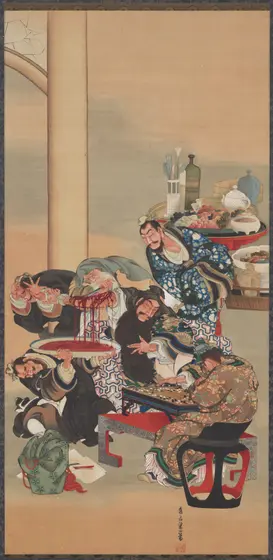
Operating on Guan Yu’s Arm, shown here, is the largest of her paintings to survive. Painted in the 1840s in ink, color and gold on silk, it measures 140.2 by 68.3 centimeters and is signed “Brush of Ōi, the woman Ei.” The Cleveland Museum of Art bought it in 1998 through the Kelvin Smith Fund, and it is in the museum’s Japanese Art department.
1 work on Morning Masterpiece