‘Umar ibn Yusuf ibn ‘Umar ibn ‘Ali ibn Rasul al-Muzaffari
‘Umar ibn Yusuf ibn ‘Umar ibn ‘Ali ibn Rasul al-Muzaffari was a Yemeni ruler of the late thirteenth century, whose reign the Metropolitan Museum of Art gives as 1295–96. The Met credits to him a brass astrolabe made in Yemen and dated 1291.
He is also known as al-Ashraf ‘Umar II. His name carries that of the Rasulids, a Sunni Yemeni dynasty that ruled Yemen from 1229 to 1454, and his short reign falls within that period.
The work that bears his name is an astrolabe. An astrolabe is an astronomical instrument known since ancient times. It serves as a star chart and as a model of the half of the sky that can be seen. With it a user can measure the height of a star or planet above the horizon, by day or by night, identify stars and planets, find the local latitude from the local time, and survey or triangulate. In its simplest form it is a metal disc with a pattern of wires, cutouts and holes. Astrolabes were used in classical antiquity, in the Byzantine Empire, in the Islamic Golden Age, in medieval Europe and in the Age of Discovery.
The astrolabe shown here is dated 1291 CE, a few years before the reign the Met gives for him. It is brass, cast and hammered, pierced, chased and inlaid with silver, and it has several parts: a case, a bar with an attached nail, a net, four plates and a pin. The case has a maximum width of 7 5/8 inches (19.4 centimeters) and a diameter of 6 1/8 inches (15.6 centimeters). The instrument came to the Met in 1891 as a bequest of Edward C. Moore, as part of the Edward C. Moore Collection, and is in the museum’s Islamic Art department.
1 work on Morning Masterpiece
-
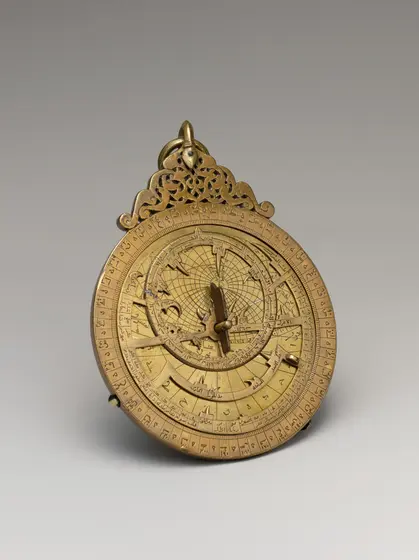 Astrolabe of ‘Umar ibn Yusuf ibn ‘Umar ibn ‘Ali ibn Rasul al-Muzaffari
dated 690 AH/1291 CE · The Metropolitan Museum of Art
Featured · Wallpaper