Thomas Cole
Thomas Cole was an Anglo-American painter of landscapes and history pictures, born in Lancashire on 1 February 1801, who founded the Hudson River School. He died in Catskill, New York, on 11 February 1848.
He painted Romantic landscapes as well as history paintings, and he also worked as an illustrator. He was prolific throughout his career and worked mostly in oil on canvas. European painters influenced him, but his work kept a strong American sensibility. He was a citizen of both the United Kingdom and the United States.
The Hudson River School was an American movement of landscape painters in the middle of the nineteenth century, whose way of seeing was shaped by Romanticism. In its early years the paintings usually showed the Hudson River Valley and the country around it, including the Catskill, Adirondack and White Mountains.
Besides The Oxbow, his best-known works include The Course of Empire, The Voyage of Life and The Subsiding of the Waters of the Deluge. His paintings are held by many museums, among them the Metropolitan Museum of Art, the Smithsonian American Art Museum, the Wadsworth Atheneum Museum of Art, the Albany Institute of History & Art, the Museum of Fine Arts Boston, the Art Institute of Chicago, the Crystal Bridges Museum of American Art and the National Gallery of Canada.
View from Mount Holyoke, Northampton, Massachusetts, after a Thunderstorm, usually called The Oxbow, is the painting shown here. Made in 1836, it is a Romantic panorama looking out from Mount Holyoke over the Connecticut River Valley just after a thunderstorm, and it has been read as a confrontation between wilderness and civilization. Cole himself appears in the picture. The canvas measures 51 1/2 by 76 inches (130.8 by 193 centimeters). Mrs. Russell Sage gave it to the Metropolitan Museum of Art in 1908, and it is in the museum’s American Wing.
1 work on Morning Masterpiece
-
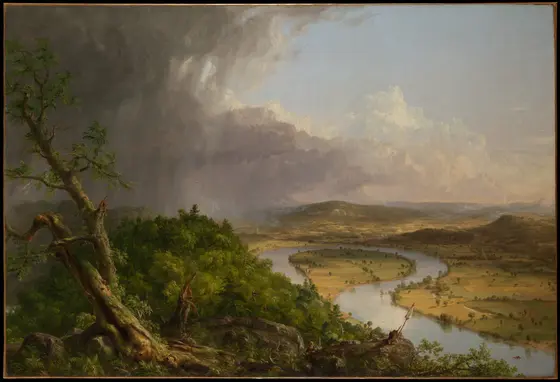 View from Mount Holyoke, Northampton, Massachusetts, after a Thunderstorm—The Oxbow
1836 · The Metropolitan Museum of Art
Featured · Wallpaper