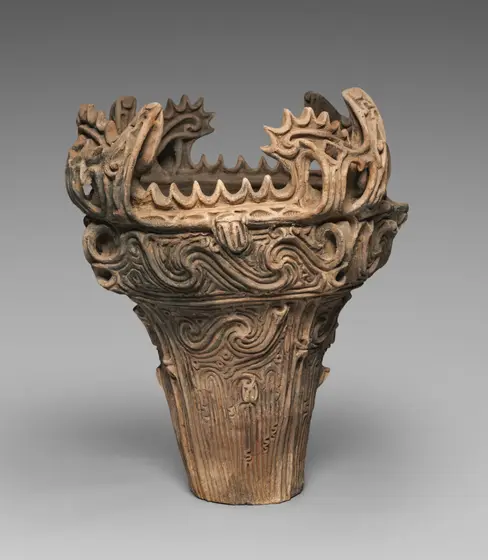
Jōmon potter
The potter who built this flame-rimmed cooking vessel in Japan about 2500 BCE is not known by name. He or she belonged to the Jōmon culture, a long prehistoric age of the Japanese islands that ended around 300 BCE.
The period takes its name from a Japanese word meaning “cord pattern,” after the marks of rope pressed into the wet clay of many of its pots. Jōmon people lived mainly by hunting, fishing and gathering, yet many communities stayed in one place for long stretches and developed a rich material culture of stone, bone and shell tools, ornaments, clay figures and lacquerware. Their earthenware is counted among the oldest pottery in the world.
Soot and food residue show that even the most elaborately decorated Jōmon pots were used for cooking, and residue tests have shown that their makers ate acorns treated to remove toxins. The pots were fired at fairly low temperatures, roughly 600 to 900 degrees Celsius, and rims became especially complex during the Middle Jōmon phase.
The vessel shown here is earthenware with carved and applied decoration, its rim rising in crests that resemble flames. It stands 61 centimeters high and was rebuilt in the 1900s with the base of another pot. The Cleveland Museum of Art bought it through the John L. Severance Fund, and it is in the museum’s Japanese Art department.
1 work on Morning Masterpiece