Iznik workshop
The makers of two Ottoman works, a tughra of Sultan Süleiman the Magnificent made in Istanbul in about 1555–60 and a tile panel made in Iznik in the early seventeenth century, are not known.
The tughra is the calligraphic insignia of Süleiman, who reigned from 1520 to 1566. It is ink, opaque watercolor and gold on paper, and the tughra alone measures 20 1/2 by 25 3/8 inches. A tughra served as a sultan’s monogram, seal or signature. It was placed on official documents and letters, carved on his seal and stamped on the coins of his reign. For important documents, very elaborate decorated versions were made as works of art in the Ottoman tradition of illumination. The Met acquired this sheet in 1938 through the Rogers Fund.
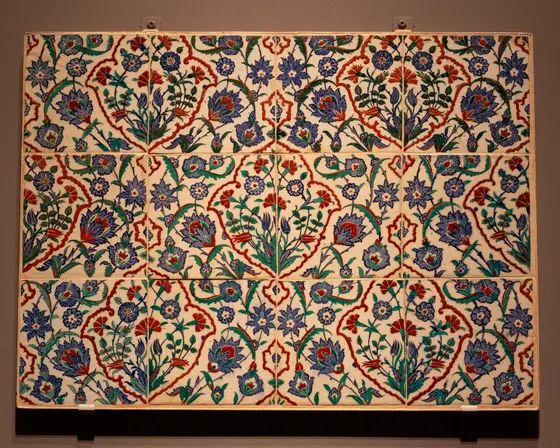
The tile panel is stonepaste, painted in several colors under a transparent glaze, and its decoration shows flowers. It is 29 inches high and 39 1/4 inches wide. J. Pierpont Morgan gave it to the Met in 1917.
Iznik is a town in Anatolia. It gave its name to Iznik ware, a decorated ceramic made there from the last quarter of the fifteenth century until the end of the seventeenth. The Ottomans wanted these wares to carry the prestige and symbolic value of Chinese porcelain without copying its designs. Their decoration adapted the International Timurid style into a bolder, more contained manner, and the method used to make them, different from that of Iranian pottery of the time, is thought to have been invented by Anatolian potters.
Both works are part of the Met’s Islamic Art collection.
1 work on Morning Masterpiece