Gustave Caillebotte
Gustave Caillebotte was a French painter, born in Paris on 19 August 1848, who belonged to the Impressionist circle and was also one of its patrons. He died in Gennevilliers on 21 February 1894.
Painting was only one of his pursuits. He was also an art collector, a lawyer, an engineer, a sailor, a designer of boats, a stamp collector, a graphic artist and an etcher. Within the Impressionist group he painted in a more realistic way than many of his colleagues, and he took an early interest in photography as an art form.
His family’s wealth allowed him to act as a patron to many of his fellow Impressionists. When he died he left his collection of their works to the French Republic, and despite considerable controversy it became the nation’s central collection of Impressionist painting. Among the paintings most associated with his own name are Paris Street; Rainy Day, Les raboteurs de parquet and Vue de toits. His work is held today by museums including the Musée d’Orsay, the Musée Marmottan Monet, the Metropolitan Museum of Art, the J. Paul Getty Museum, the Thyssen-Bornemisza Museum, the Van Gogh Museum and the Art Institute of Chicago.
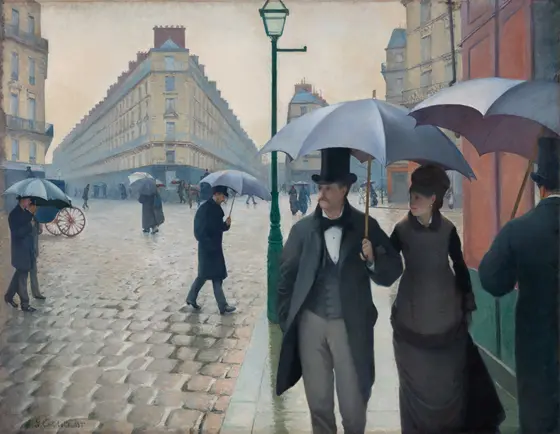
Paris Street; Rainy Day, painted in Paris in 1877, is the work shown here. The large oil on canvas, 212.2 by 276.2 centimeters, shows people on foot crossing a boulevard intersection in the rain, at what is now the Place de Dublin in the eighth arrondissement. It is the best known of his cityscapes tied to the rebuilding of Paris under Napoleon III and Georges-Eugène Haussmann, and it sums up his ideas about modern life.
The Art Institute of Chicago, which holds the painting in its Charles H. and Mary F. S. Worcester Collection, calls it Caillebotte’s masterpiece. The museum points out that the clothes are the latest fashion, that the retractable umbrella had just been invented, and that the wide boulevards were the result of a renovation lasting decades that replaced the city’s medieval streets.
1 work on Morning Masterpiece