Claus de Werve
Claus de Werve was a Netherlandish sculptor who carved for the dukes of Burgundy in Dijon for more than forty years and finished the great tomb of Philip the Bold. Born about 1380, probably in Haarlem, he died in Dijon in 1439.
In 1396 he joined the Dijon workshop of his uncle, Claus Sluter, sculptor to Philip the Bold, and worked with him on the Well of Moses at the Carthusian monastery of Champmol. After Sluter’s death, around 1406, de Werve took his place as chief sculptor to the Burgundian court. In 1408 he travelled to Savoy at the invitation of Duke Amadeus VIII.
Philip the Bold’s tomb had been begun by Jean de Marville and carried on by Sluter, and the duke died in 1404 with it still unfinished. De Werve completed it in 1410, carving the angels and almost all of the small alabaster mourners that walk in procession beneath the effigy, each with its own face and gesture and with drapery that carries much of the grief. The Virgin and Child of Poligny in the Metropolitan Museum of Art is also attributed to him. Jean de la Huerta succeeded him as court sculptor.
The mourner shown here comes from that tomb and dates from 1404–10. Carved in Vizille alabaster, it stands 41 centimeters high, and a plaster cast of it fills its place on the tomb in Dijon. It came to The Cleveland Museum of Art as a bequest of Leonard C. Hanna Jr., and it is in the museum’s Medieval Art department.
1 work on Morning Masterpiece
-
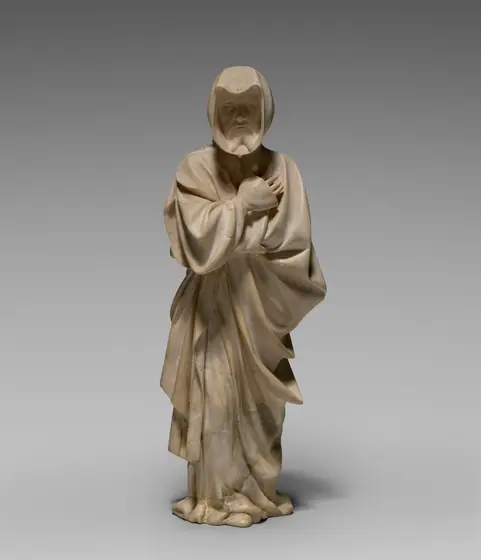 Mourner from the Tomb of Philip the Bold, Duke of Burgundy
1404–10 · The Cleveland Museum of Art
Featured · Wallpaper