Claude Monet
Claude Monet was a French painter and a founder of Impressionism. He was born Oscar-Claude Monet in Paris on 14 November 1840 and died in Giverny on 5 December 1926.
Monet is seen as a key forerunner of modern art, above all in the way he tried to paint nature as he himself saw it. Across his long career he pursued the Impressionist aim of recording one’s own perception of nature, especially in landscapes painted out of doors, and he is regarded as its most consistent and productive practitioner. He worked as a painter and also as a graphic artist.
The word Impressionism comes from the title of his painting Impression, Sunrise. It was shown in 1874 at the first Impressionist exhibition, which Monet and a group of artists who shared his ideas set up as an alternative to the Salon. His other works include the Water Lilies, the Rouen Cathedral series, the Haystacks, The Magpie, Woman with a Parasol – Madame Monet and Her Son, Garden at Sainte-Adresse, Women in the Garden and Luncheon on the Grass.
His works are held by a great many museums around the world. They include the Musée d’Orsay, the Musée Marmottan Monet, the Musée de l’Orangerie, the National Gallery, the Metropolitan Museum of Art, the Museum of Modern Art, the Hermitage Museum, the National Museum of Western Art and the Art Institute of Chicago.
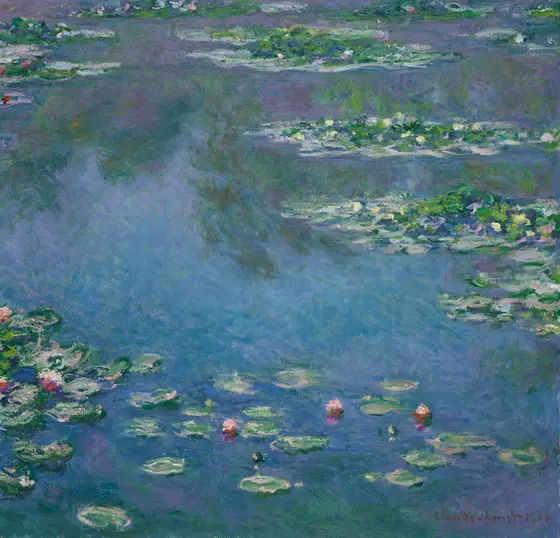
Two of his paintings in the Art Institute of Chicago appear here. Water Lilies, dated 1906, oil on canvas, 89.9 by 94.1 centimeters, shows water lilies and reflections on a pond in blues and greens; it is part of the Mr. and Mrs. Martin A. Ryerson Collection. Stacks of Wheat (End of Summer), 1890–91, oil on canvas, 60 by 100.5 centimeters, belongs to the series of wheat stacks near his house at Giverny that he showed together at the Galerie Durand-Ruel in Paris in 1891; it was a gift of Arthur M. Wood, Sr. in memory of Pauline Palmer Wood. Both are in the museum’s Painting and Sculpture of Europe department.
1 work on Morning Masterpiece