Chola artist
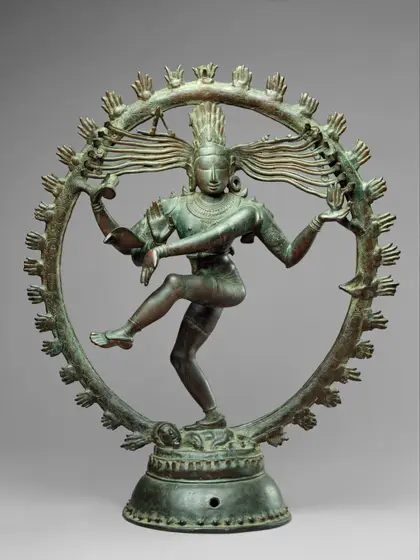
This figure of Shiva as Lord of Dance (Nataraja) was made by an unknown artist in Tamil Nadu, India, during the Chola period (880–1279). It dates from about the late eleventh century and is made of copper alloy. It shows the god Shiva in his form as a dancer.
Nataraja, also known as Adalvallan, is the form of Shiva, one of the main gods of Hinduism, as the divine cosmic dancer. His dance is called the tandava. Various Tamil texts also give the form the names Kuththan, Sabesan and Ambalavanan.
The pose and the image are described in many Hindu texts. These include the Tevaram and the Thiruvasagam in Tamil, the Amshumadagama and the Uttarakamika agama in Sanskrit, and the Grantha texts. The dancing image is found in every major temple of Shaivism. It is a well-known sculptural symbol in India, widely used to stand for Indian culture, and is often held up as one of the finest examples of Hindu art.
The figure shown here is 26 7/8 inches (68.3 centimeters) high and 22 1/4 inches (56.5 centimeters) in diameter. R. H. Ellsworth Ltd. gave the figure to the Metropolitan Museum of Art in 1987, in honor of Susan Dillon. It is in the museum’s Asian Art department in New York.
1 work on Morning Masterpiece