Caravaggio
Caravaggio painted saints and martyrs from living models, lit by a hard beam of light against deep shadow, and his way of working reshaped European painting at the start of the Baroque. Born Michelangelo Merisi in Milan on 29 September 1571, he grew up in the nearby town of Caravaggio, which gave him his name, and he died at Porto Ercole, on the Tuscan coast, on 18 July 1610.
In 1584 he began a four-year apprenticeship in Milan with the painter Simone Peterzano. He moved to Rome in the early 1590s and made his name there, both as a painter and as a quarrelsome and violent man. In May 1606 he killed Ranuccio Tomassoni in a fight, was sentenced to death and fled south to Naples. He went on to Malta in 1607 and to Sicily in 1608, came back to Naples in 1609, and died the following year while travelling toward Rome in hope of a pardon. The cause of his death is still debated.
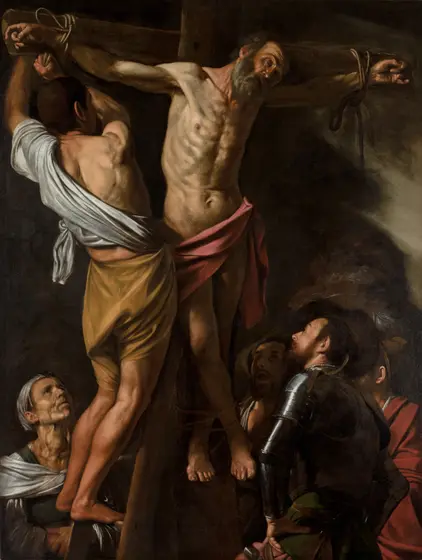
Caravaggio usually painted straight onto the canvas without preparatory drawings, setting his figures in strong light against darkness, a manner later called tenebrism. Followers known as the Caravaggisti spread it across Europe, and Rubens, Ribera, Velázquez and Rembrandt all learned from it. His reputation faded after his death and revived in the twentieth century.
The Crucifixion of Saint Andrew, shown here, was painted in Naples in 1606–7 and first belonged to the Count of Benavente, the Spanish viceroy there. It is oil on canvas, 202.5 by 152.7 centimeters, and the only altarpiece by Caravaggio in America. The Cleveland Museum of Art acquired it in 1976 through the Leonard C. Hanna Jr. Fund.
1 work on Morning Masterpiece