Artemisia Gentileschi
Artemisia Gentileschi was an Italian Baroque painter, born Artemisia Lomi Gentileschi in Rome on 8 July 1593. She is counted among the most accomplished artists of the seventeenth century.
She began by working in the manner of Caravaggio and is grouped with his followers, the Caravaggisti. She was already producing professional work at the age of fifteen. At a time when few women could train or work as professional artists, she became the first woman member of the Accademia di Arte del Disegno in Florence, and she had clients in several countries.
From 1638 to 1642 she worked as a foreign painter at the court of Charles I of England. She is thought to have left England in the early stages of the English Civil War. Where she lived over the next few years is unknown, but she appears again in Naples in 1649. Her last known letter to one of her mentors, written in 1650, shows that she was still painting. She died in Naples. The date of her death is uncertain, but her last known commission dates from January 1654.
Her best-known works include Judith Slaying Holofernes, Judith and Her Maidservant, Susanna and the Elders, Allegory of Inclination, Self-Portrait as a Female Martyr and an Adoration of the Magi. Museums and collections holding her paintings include the Uffizi Gallery, the Palazzo Pitti, the Casa Buonarroti, the Museo di Capodimonte, the Museo del Prado, the Royal Collection, the Detroit Institute of Arts and the Metropolitan Museum of Art.
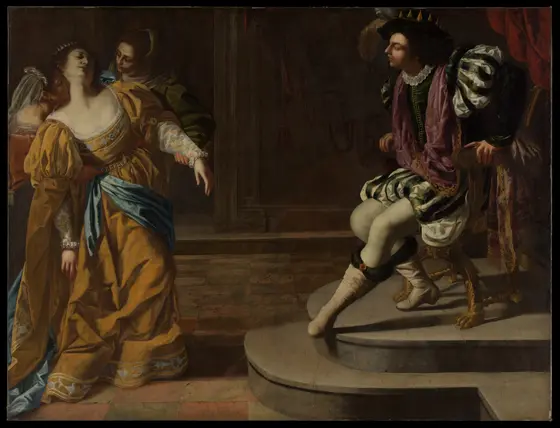
Esther before Ahasuerus, the painting shown here, is oil on canvas and dates from the 1620s. It shows the biblical heroine Esther coming before Ahasuerus to plead with him to spare her people. It is one of her less familiar works. The canvas measures 208.3 by 273.7 centimeters. Elinor Dorrance Ingersoll gave it to the Metropolitan Museum of Art in 1969, and it belongs to the museum’s European Paintings department.
1 work on Morning Masterpiece